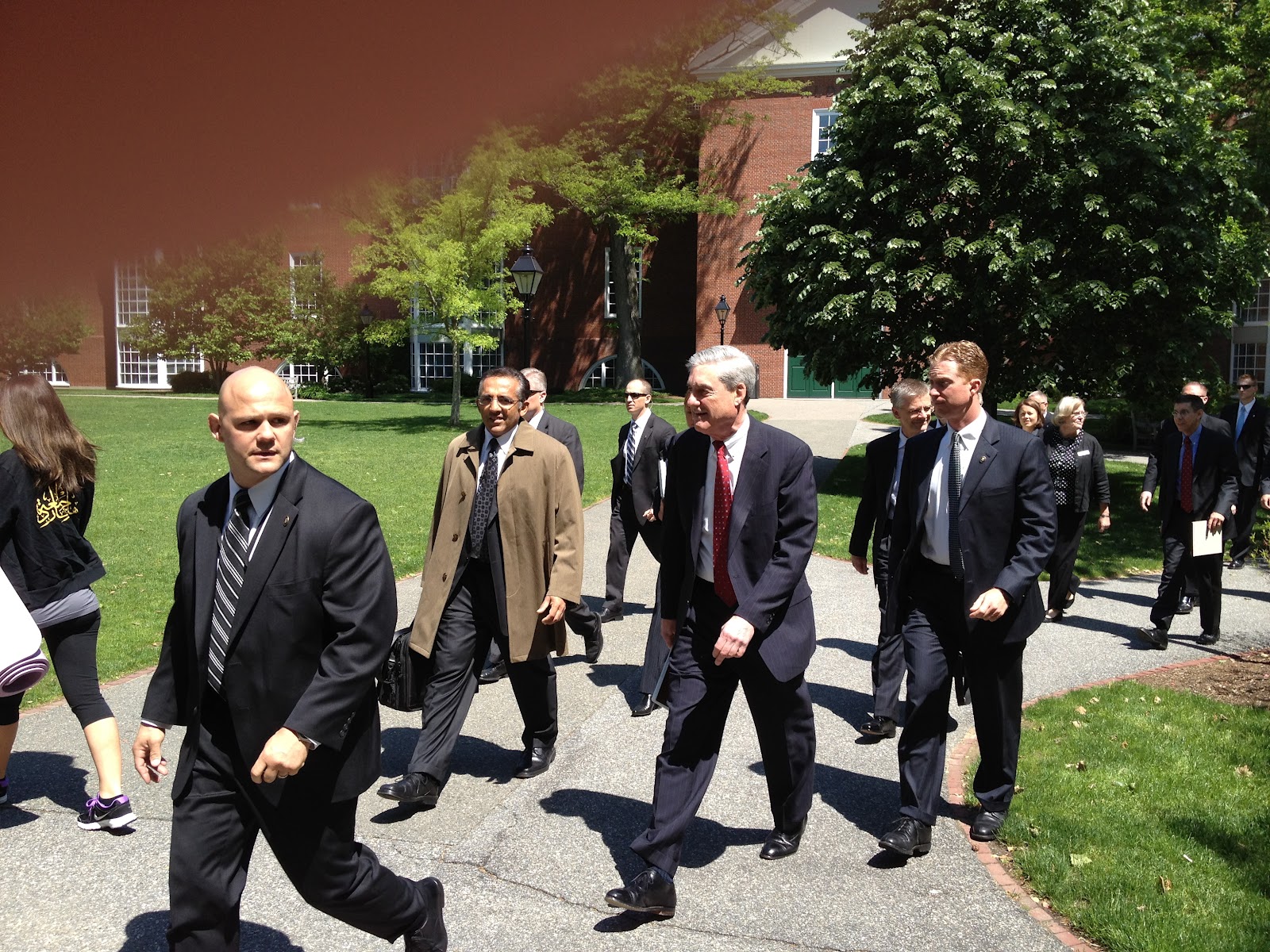
Robert Mueller
A lot of what I know about Mr. Mueller comes from the materials I have read about him and his work at what is indisputably the best law enforcement agency in the world - the Federal Bureau of Investigation.
By all accounts he has presided over the biggest overhaul of the FBI since it was founded by Charles Bonaparte in 1908. The impetus for such a change was brought on by the events leading up to the 9/11 tragedy, where the entire intelligence and law enforcement community of the United States was found wanting and plagued by inefficiency.
Mr. Mueller steered the bureau through those tumultuous times through strength of character and integrity, an unwavering vision of how the FBI can best serve the American public and a first-rate management acumen that allowed him to instill the right culture, processes, people and strategy.
Message
One of my most poignant and unforgettable moments in Harvard Business School's (HBS) Advanced Management Program (AMP), was my close encounter with Mr. Mueller. He had just finished delivering his lecture to the class and had opened the floor to questions. I raised my hand and began to ask him what I described as "two-part question that centers on controls" and proceeded to finish my question. His immediate response to me was, "are you a journalist"? To which I replied, "No, I'm from the Philippines." He then retorted, "I KNOW", a trailed off with a mysterious smile that only the world's top cop can credibly give.
Throughout his two-hour interaction with students of the AMP, Mr. Mueller displayed his intellectual brilliance, strength of character, wit, management acumen, charisma and integrity - all of which make him perfect for his job and also the best spokesperson for the agency, which by all accounts he so loves.
The American people are indeed very fortunate to have a man such as Mr. Mueller lead the fight for a just and safe society. Americans sleep soundly at night because of people like him.
I would like to share some of Mr. Mueller's thoughts:
Some lessons post 9/11:
Needless to say, the class's interactions with world-class and proven leaders, shaped and strengthened by crisis, would not have been possible if it were not for the tireless and diligent efforts of Professor on Leadership, Ranjay Gulati. It is so easy to underestimate his course going in, but it would be difficult to underestimate its impact on your person and leadership acumen, coming out.
Here are some more photos of Director Mueller.


 |
| FBI Director, Robert Mueller, addresses participants of Harvard's Advanced Management Program |
Robert Mueller
A lot of what I know about Mr. Mueller comes from the materials I have read about him and his work at what is indisputably the best law enforcement agency in the world - the Federal Bureau of Investigation.
By all accounts he has presided over the biggest overhaul of the FBI since it was founded by Charles Bonaparte in 1908. The impetus for such a change was brought on by the events leading up to the 9/11 tragedy, where the entire intelligence and law enforcement community of the United States was found wanting and plagued by inefficiency.
Mr. Mueller steered the bureau through those tumultuous times through strength of character and integrity, an unwavering vision of how the FBI can best serve the American public and a first-rate management acumen that allowed him to instill the right culture, processes, people and strategy.
Message
One of my most poignant and unforgettable moments in Harvard Business School's (HBS) Advanced Management Program (AMP), was my close encounter with Mr. Mueller. He had just finished delivering his lecture to the class and had opened the floor to questions. I raised my hand and began to ask him what I described as "two-part question that centers on controls" and proceeded to finish my question. His immediate response to me was, "are you a journalist"? To which I replied, "No, I'm from the Philippines." He then retorted, "I KNOW", a trailed off with a mysterious smile that only the world's top cop can credibly give.
Throughout his two-hour interaction with students of the AMP, Mr. Mueller displayed his intellectual brilliance, strength of character, wit, management acumen, charisma and integrity - all of which make him perfect for his job and also the best spokesperson for the agency, which by all accounts he so loves.
The American people are indeed very fortunate to have a man such as Mr. Mueller lead the fight for a just and safe society. Americans sleep soundly at night because of people like him.
I would like to share some of Mr. Mueller's thoughts:
Some lessons post 9/11:
- Counter-terrorism is the agency's number one priority
- agency was reorganized and staffed to support this priority
- promotion and advancement programs require a stint in counter-terrorism
- cultural and procedural changes were put in place and continue to be fine-tuned
- Threats
- There was confusion on which branch of law enforcement is responsible for counter-terrorism (domestic vs. international; criminal vs. intelligence)
- Didn't know source and extent of attack
- Need to balance civil liberties and the need to address these threats
- Flexibility
- balancing what the agency's strength and what the agency needs to be stronger
- training the agents to have the right behavior and make the right decisions
- establishing clear priorities that are communicated across the organization
- begins with hiring the right people and doing this requires establishing the right criteria that is anchored on the right values
- respect for civil liberties and that interdiction can pass the American criminal justice system
- need to be aggressively apolitical while being respectful of the public political discourse
- Identify causes of failure and need for change
- Know what to and how to bring climate of change while being flexible and adaptive
- Put in the right infrastructure - both people and hardware
- Be transparent and open to suggestions
- you will not get it 100% right the first time
- listen and adopt the suggestions of your team
Needless to say, the class's interactions with world-class and proven leaders, shaped and strengthened by crisis, would not have been possible if it were not for the tireless and diligent efforts of Professor on Leadership, Ranjay Gulati. It is so easy to underestimate his course going in, but it would be difficult to underestimate its impact on your person and leadership acumen, coming out.
Here are some more photos of Director Mueller.